

It should be a moment of reckoning for British journalism. It’s said almost as an aside - an offhand comment, issued with a self-satisfied smile - but its implications are devastating.
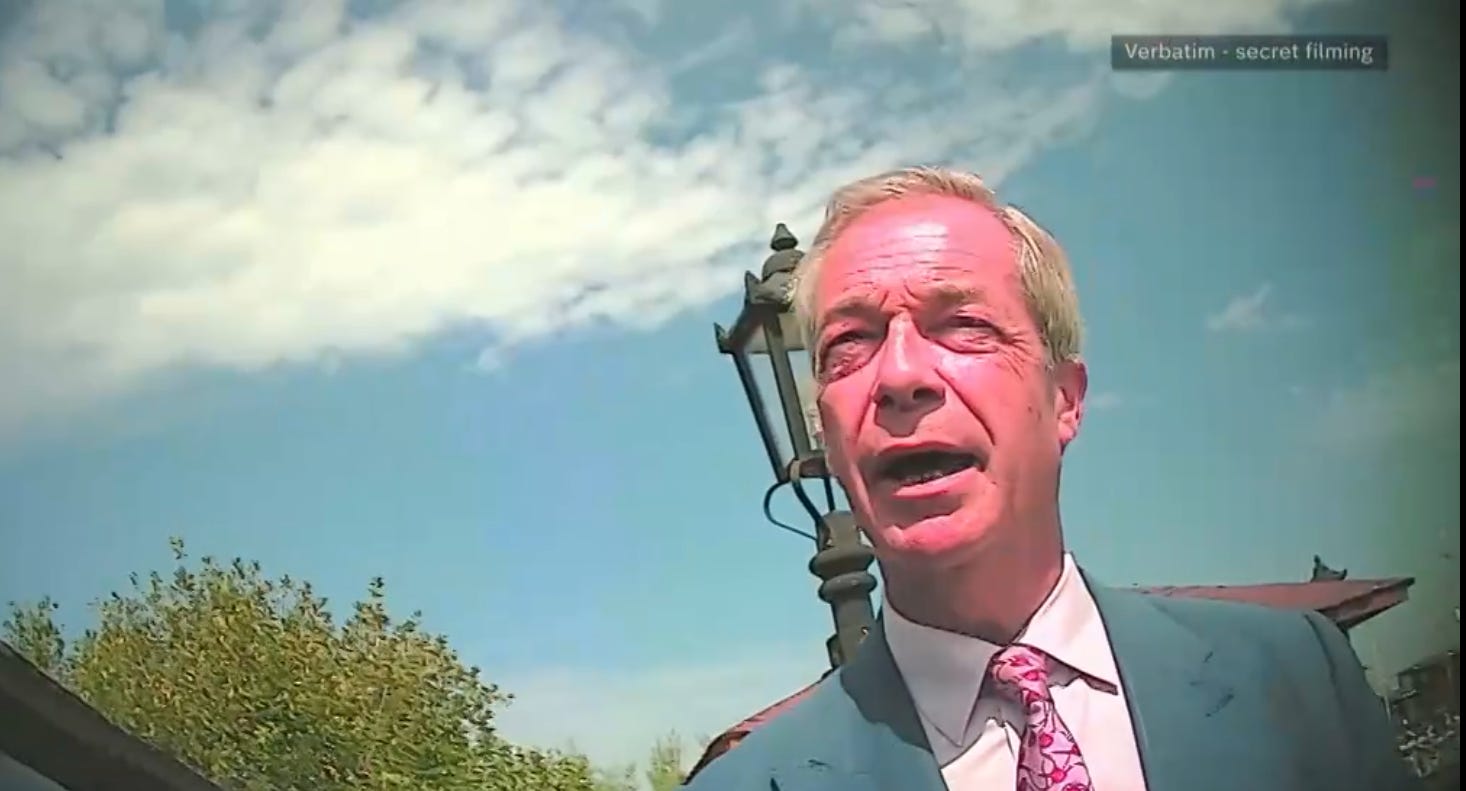
Nigel Farage is sitting outside, eating oysters and drinking champagne with a potential donor from the US. He doesn’t know it yet, but he is the victim of an undercover sting operation by Channel 4 News and Verbatim. The donor, played by an actor, comments on how cheaply and effectively he can use his money to influence UK newspaper coverage, through the clandestine funding of polls. “£30,000,” he says, as if startled by how cost-effective it all is. “Amazing,” Farage confirms. “Front page of the Times.” They’re boasting about how easy it is to hack the British press in favour of a political party. They’ve put a price tag on it.
In the weeks since the Channel 4 sting, we have rightly talked a lot about how it reflects on Farage and Reform. But we have spoken much less, or not at all, about how it reflects on the British polling industry, British journalism, and the space in which they come together. The sting revealed that for a relatively small sum of money a PR campaign - political or otherwise - can secure the front page of a leading national newspaper with their chosen message.
The polling industry at least had the decency to be mortified. The newspapers involved - the Times and the Telegraph - barely even mentioned it. They deleted the stories they once carried, buried all mention of their role in the ensuing scandal, and then acted like it never took place. Didn’t learn a thing. Didn’t apologise for a thing. Didn’t change a thing.
Here’s what happened in the Channel 4 sting. Undercover reporters posing as donors reached out to Reform and were quickly introduced to figures high up the hierarchy - first James Orr, a supposed theologian, and then Dan Jukes, a young Farage aide. Both of them acted like the consigliere of an incoming Farage government.
They are caught on camera enacting a plan in which they take donations from the foreign donor and effectively launder them through the purchasing of various opinion polls, which are then used to spread Reform’s message in the press. They do this through James Johnson, cofounder of polling company JL Partners.
In the secretly-taken videos, Johnson clearly states that he took the contract from Reform, kept the identity of his client secret, and then promoted the polls himself to a newspaper without revealing that they were commissioned and paid for by the very people the polling benefitted.
“I think there’s a little bit of informal rule bending that we did with our last one,” he says. He then goes on to describe something that is not rule bending, but in fact the shattering of basic principles. “When we published those results we should have disclosed who the client was. Basically the way that that worked…. was Dan [Jukes] gave me a call and said: ‘Look we want to do this polling of councils to show X’... We came back and then we just went and did it.”
This poll was later reported by the Telegraph on its front page, without any mention of the fact that it was funded by Reform. In fact, the copy, which has now been deleted by the newspaper, read: “according to polling for the Telegraph”. The undercover reporter asks Johnson about this. Why did they claim it as their own? Johnson replies: “It’s classic right? It’s that kind of like: ‘I’ve got a good story for you here.’ For them, it’s copy… ‘Can we call it an exclusive’?’ Yeah, brilliant.”
The undercover reporter replies: “And it’s better than them going and saying ‘commissioned by Dan Jukes’.”
“Yeah well indeed. I mean, that’s never going to happen, because we’d never let that happen.”
“And in fact they don’t even know that right?”
“No, no, exactly. They would never know that. God no.”
From this we learn several things. First, that Johnson is confessing to keeping the identity of the person who funded the poll secret. This contravenes Section 2.1 of the British Polling Council’s Objects And Rules, which states that: “All data and research findings made on the basis of social or political polls conducted in the United Kingdom by member organisations that enter the public domain, must include reference to the… client commissioning the survey”.
It is also against the pretty much entire motivating spirit of the Market Research Society’s Code of Conduct, which demands that members “ensure that their professional activities can be understood in a transparent manner”.
His comments about the Telegraph reveal two things. First, that it did not know that the polling was funded by Reform. So the newspaper is not guilty of assisting in the alleged deception, but in fact seems to have been deceived itself. However, it did participate in a little deception of its own, telling readers that it was “polling for the Telegraph”.
The polling technique seems to have two purposes. First, it allows foreign donations to reach Reform through the funding of opinion polls. Secondly, it turns British opinion polling into a political weapon.
The undercover reporters later speak with Dan Jukes, after another poll has been published in the Telegraph without any mention of who funded it. He describes his relationship with Johnson as “a really, really discreet one”. What does that mean? Anonymity. “If you read it, it was completely hands off, fingerprints off. And yet… it was a big story in the Telegraph on page six, on the top left of the Telegraph as well, which stood up the public support for our slogan”.
That last part is key. This type of polling is being designed to corroborate Reform messaging. There is no suggestion it is inaccurate or even sloppily conducted - as far as we can tell the polls were methodologically sound and accurately reflected public sentiment at the time. It’s just that they were selected and pitched in the most useful way for Reform. No-one would trust a poll funded by Reform itself, but they will trust one by a polling company or a newspaper.
“Those little clandestine projects are so valuable for the sake of four and a half grand,” Jukes said. “I can’t tell you how useful they are.”
Even when polls are not specifically tailored to a Reform campaign, they help the party by providing a sense of electoral inevitability. For nearly two years, Reform was soaring at the top of the polls, averaging results in the low 30s. This allowed them to make a compelling case that they were a government in waiting. Farage started doing weekly press conferences, surrounded by the mock-up gravitas of government, as if poised to enter Downing Street. Journalists covered the party with breathless abandon.
This was not just useful to Reform in terms of its future success, it allowed it to try to change policy in the here and now, despite only having a handful of MPs. In July last year, deputy Reform leader Richard Tice wrote a letter to energy company bosses. “Reform UK is now leading in the national opinion polls,” he said. “A future government led by Nigel Farage is now more likely than not.” He then warned them not to take part in clean energy auctions. “I am writing to put you and your investors on formal notice,” he said, before making it clear that a future Reform government would rip up contracts signed under the existing Labour government.
The letter was an attempt to use Reform’s polling advantage to destroy the Net Zero agenda.
What’s being revealed here is a complex network of financial and political aims. Sure, the polling served to conceal funding streams. But it also acted to secure concrete political outcomes away from any kind of transparency or democratic oversight. This dual financial and ideological role is very common to populist movements. As I wrote back in spring after the fall of Viktor Orban:
“This is one of the things which people often fail to grasp about populism. They treat the corruption as an unrelated secondary narrative to the main ideological agenda. But in fact they are both elements of the same agenda. The corruption buys loyalty. It creates a closed eco-system of funding for regime-friendly voices. It secures allies in place across the constitutional landscape. Corruption is the means by which a regime can replace accountable liberal institutions with closed personal networks.”
We know how Reform operate and we know what they want. But we have spent very little time looking at what this story reveals about polling and journalism. It is now very clear that they are vulnerable to populist manipulation. They are exposed.
How has this happened? As usual, the internet is to blame.
First, it removed barriers to entry. Until relatively recently, polling was a difficult business to get into, because it involved a lot of capital. You needed banks of people on the telephone doing research, or to send out knocking on doors. Now it doesn’t really take any capital at all, just a laptop, some software, and a little bit of money to buy respondents from a third party. All sorts of little bespoke companies now pop up, some of them with questionable credentials.
Simultaneously, the internet destroyed journalism’s financial model, because it made the product free and slashed advertising revenue. This meant that newspapers had less money to commission polls themselves and instead began to rely on other organisations to fund the polls which they would cover.
It also had a broader effect on the quality of polling coverage. Journalists who used to write one story a day now write half a dozen. Specialist editors were gradually let go and replaced by generalists. Most journalists now simply have no idea how to intelligently appraise a poll. They don’t understand, or do not care, about how certain questions can prime a respondent to answer in a particular way. They do not know the difference between sampling, where you try to control the demographic mix of respondents ahead of a poll, and weighting, where you get a mass of results and then weigh them to be demographically representative after a poll.
Political polling also has a weird financial tension within it. Clients come asking for polls and they usually have something they want those polls to conclude. Take the Brexit era. If a Remain organisation came up to you, they would prefer a poll that says that the public have changed their mind about Brexit and want to stay in the EU. If a Leave organisation comes up to you they want one that says the opposite. The same for charities and pressure groups - they want a poll that chimes with their goals, whether it’s about rent controls, animal cruelty, assisted dying or whatever else.
So the client would ideally like the methodological discipline of the polling company to be as lax as possible. Good rigorous methodology is also more expensive than bad methodology. So there are two specific financial incentives which act to lower standards.
Given that this is the case, why haven’t polling standards collapsed entirely? Part of the reason is cultural. Pollsters - especially for the big companies like YouGov or Ipsos Mori - are generally serious conscientious people, the type of person who loses sleep at night about defects in their weighting models. Generally speaking, they care that they are doing a good job. They want to provide utility. They base their professional and personal pride on the quality of the work they produce.
Another part of the reason is economic. The clients who want shoddy data are usually the ones who contribute the least financially. They want four questions on whatever policy they support showing that the public love it so they can wrap it into a press release. It’s probably worth a couple of grand. You can’t base your business strategy on clients like that.
The real money in polling comes from clients who want decent data. This is primarily commercial clients - pension funds, major companies releasing consumer products, and so on. But it also includes public sector bodies, academics and think tanks. It’s no use to a toothpaste company if you give them crap data - they need solid research so they can market their product effectively. It’s no use to researchers if they cannot guarantee the quality of the empirical base they are resting their study on.
If pollsters did what pressure groups wanted, they would eventually undermine their credibility, which would make it harder for them to secure the contracts which pay the serious money.
What concerns me about this arrangement is that this funding situation may now change. And the reason it could change is because of these new megawatt Reform donations.
Reform is now awash with money, on a scale well beyond anything we have seen in British politics. It has secured massive donations from hyper wealthy figures in crypto, like Ben Delo and Christopher Harborne, who last week donated a total of £72 million to the party, on top of their previous contributions.
In policy terms, the effects are obvious. Reform has hardly any fleshed out policy, but on crypto it has a strikingly detailed set of very specific ideas - abandoning work on a digital pound, cutting tax on crypto profits, establishing a bitcoin reserve fund, and so on. This all comes from a party which literally does not even have a defence spokesperson.
In electoral terms, it means that Reform now has more money than any party in the history of British democracy. In the last full quarter alone, Reform received four times as much as all the other political parties combined. And that provides a dangerous new incentive in the polling industry.
There is a limit to the damage, in that there’s only so much national polling you can do. But the party could start funding constituency polling and focus groups - there’s more than enough cash to do so and they both cost quite a bit of money. Gradually the incentives on polling companies could start to change. We know how this works, because it has happened in the US. Across the Atlantic there are very wealthy pollsters who service only Democrat or Republican clients.
When we say that American levels of money will create American style politics, this is the kind of thing we’re talking about.
How do we stop it?
Polling currently operates according to two codes with separate enforcement procedures. One lies with the British Polling Council and the other lies with the Market Research Society.
The British Polling Council was a kind of pact which pollsters entered into because they wanted long term transparent rules for their own industry. It became a mark of respectability. This is mainly because its former president was John Curtis, who has this odd and - let’s be honest - really rather silly messiah reputation in news broadcasting, like a kind of psephological Gandalf. Journalists therefore learned to look out for a polling company’s membership of the British Polling Council as proof of its credibility. The current president is professor Jane Green, who is also held in very high regard.
But actually the British Polling Council code is pretty limited. It covers transparency, but not methodology. You could write your poll in crayon and frame the question ‘Andy Burnham eats children, do you support Andy Burnham’ and you will still be OK under the code as long as you release the data transparently. As the Council itself states: “We do not have a remit to police polling methodology, and for this reason members are not allowed to use BPC membership as any form of quality accreditation.”
The Market Research Society, on the other hand, has a more thorough set of requirements. It does have rules on methodology and wording, albeit fairly vague. Rule 28 insists that “participants are not led toward a particular point of view” and that responses are “capable of being interpreted in an unambiguous way”. Rule 64 insists that if a client “incorrectly or misleadingly” reports a poll, the polling company must “refuse permission for the client to use the member’s name further in connection with the incorrect or misleading published findings” and “correct any incorrect or misleading reporting”.
The most important thing that can happen now is firm action from these two bodies. Both of them have undertaken an investigation into Johnson. It really is important that cases like this are handled quickly and decisively.
Polling at least has a community of people who are fiercely committed to maintaining standards. See for instance this very good newsletter by Mark Pack in the wake of the scandal. Journalists, on the other hand, are seemingly incapable of asking searching questions about their own industry.
JL Partners polls in the Channel 4 sting were published by the Times and the Telegraph, in extremely prominent positions. There is no indication that these newspapers knew the polls were funded by Reform. In fact it seems very likely they did not, given that Johnson said: “They would never know that.”
Both newspapers leapt on this to defend themselves from any kind of blame. In its statement to Channel 4, the Times said: “The Times was not made aware of Reform’s involvement in commissioning and arranging payment of the poll.” The Telegraph said: “We are reviewing our future relationship with this polling company as we believe we have been misled.”
But when it came to discussing their own role in the story, the newspapers suddenly became coy. As Private Eye pointed out this week, the Telegraph mentioned it on the 34th paragraph of a story on page four - a world away from the prominent front page position it gave the poll itself last January. The Times at least put the scandal on the front page, but the news story did not mention its own role at all - it was left to a Fraser Nelson column on page 21 to reveal the paper’s involvement in what went on, followed by a brief furtive mention in a leader column. Both papers deleted all evidence of the original stories from their websites.
If this had been about the BBC promoting polls secretly funded by the Labour party, all hell would have broken loose. It would have triggered weeks of damning coverage by the papers, dominating the news agenda to the exclusion of all other matters, and probably leading to the resignation of the director general. But when it concerns the right-wing press, they just bury it like nothing had happened. No-one ever speaks about it again.
The fact that the papers were misled is entirely true. But it is also true that they do not seem to have asked about the funding of the poll.
In one sense, this is entirely normal. I’m not a reporter - columnists are basically tourists in the world of current affairs - but for what it’s worth I wouldn’t have asked about the funding either. If someone from a polling company called me up to tell me about a poll and did not mention who had funded or commissioned it I would have assumed that it came from the pollster themselves, because that is literally always the case. It’s likely that this is what the Times and Telegraph did.
Fair enough. But we can evidently no longer trust in that to be the case and will have to be more careful in future. The burying of the press’ involvement means we will not learn those lessons.
We need a much better understanding about how journalists should evaluate the validity of polls. We need to ensure we know who funded and commissioned the poll before publishing it. We should only treat a pollster seriously if it is a member of both the British Polling Council and the Market Research Society. And we should have some kind of basic grounding in polling methodology, including leading questions, priming, order effect, the role of ‘don’t know’, sampling, weighting, and so on.
We are in a uniquely dangerous position here. By and large, polling has an honourable track record. Fundamentally, it is conducted by decent people trying to do the right thing with a financial model that rewards their best instincts. But now the Reform money is coming. A great wave of it. And the party has demonstrated that it is prepared to use money to corrode the basic standards of the society it operates in.
Pollsters and journalists should be alive to that threat. Seeing the response of many polling experts in the last few weeks suggests that they are nervous about what is happening and keen to mitigate against it. Seeing the response of journalists, which has been basically non-existent, suggests the precise opposite.
That moment in the Channel 4 video - “£30,000… Front page of the Times” - should haunt everyone in this industry. The fact it has been barely mentioned is damning.
Odds and sods
You can listen to this newsletter as a podcast at the top of the page or on Spotify. You can follow me on BlueSky, Instagram or TikTok.
This week’s column for the i paper was on the good people of Piddington, who voted to leave the UK, and why we should robustly encourage them to do precisely that. Read it here.
Our Origin Story Live at the Union Chapel is out now as a podcast, where we tell the story of the Daily Telegraph and the general intellectual and editorial decline of the British conservative press. You can listen to it here.
This week’s report to Late Night Live in Australia is about Ed Miliband’s decision to bar trade with Israeli settlements in the West Bank and Donald Trump’s halfwitted intervention in Ireland. You can listen to it here.
While I was away I read The North Waters by Ian McGuire - a mean, vicious, bleak little literary thriller about a Victorian whaling ship in the Arctic and the absolute copper-bottomed bastards who populate it. It’s stark and brittle, with a proper viciousness to it. If you took out all the sections talking about bodily fluids you could fill 20 pages. I loved it.
Right, that’s your lot folks - see you next week. Fuck off.
Thanks for this Ian, this story has already been forgotten as the 24/7 media environment moves on, but you cover it in the detail it deserves. The point about Tice's letter on influencing net zero policy was particularly interesting. Farage has blatantly 'got away' with this as his Blackshirts have changed the 'narrative'. We're losing the propaganda war and the press need to share a large part of the blame
This < 2-minute clip from Yes Minister should be compulsory viewing as part of the Civics classes that should be introduced as part of the national curriculum
https://www.youtube.com/watch?v=6GSKwf4AIlI&pp=ygUSeWVzIG1pbmlzdGVyIHBvbGxz