

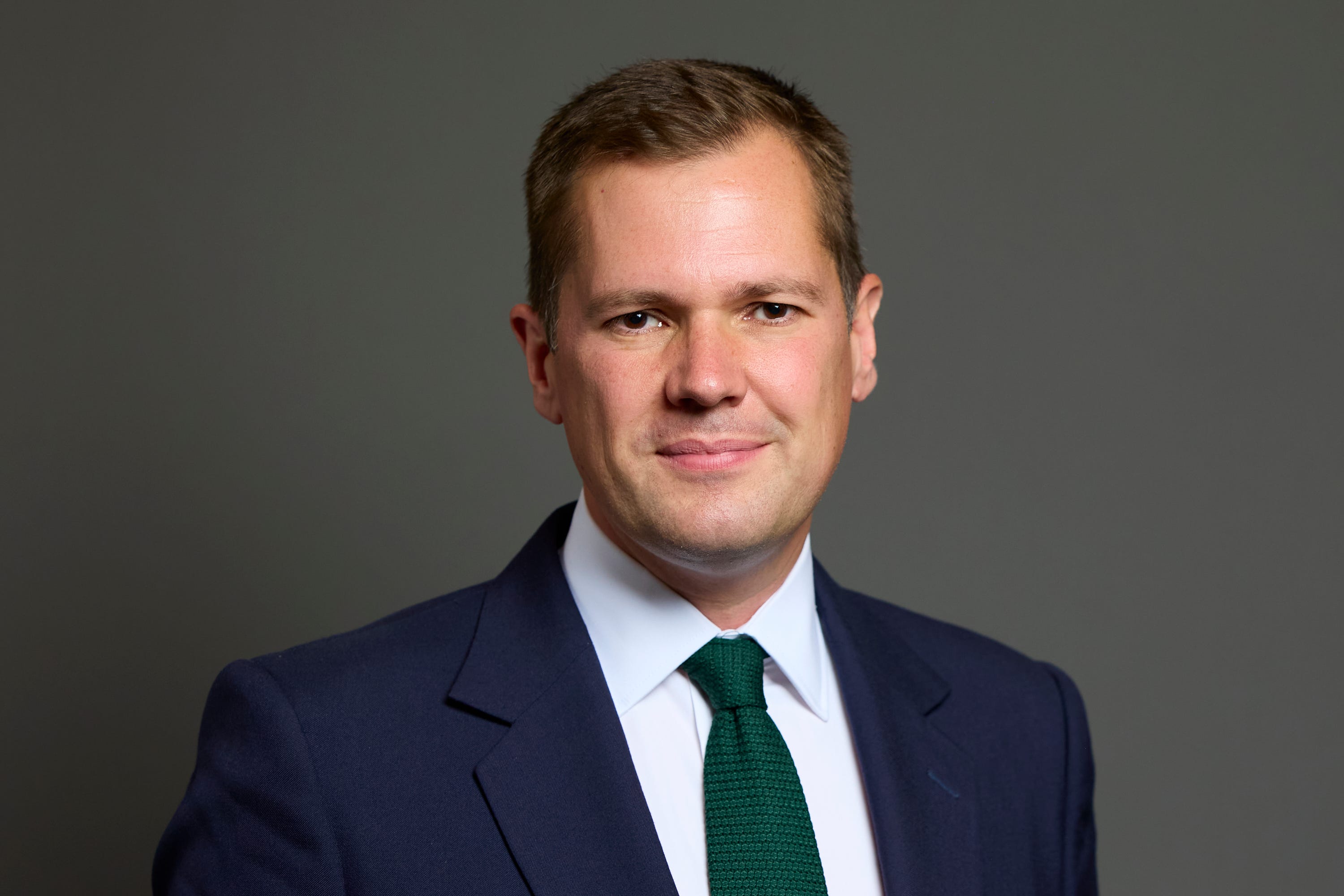
We are entitled to better villains. If we’re really condemned to fight a childlike battle between good versus evil, we at least deserve to face monstrous physical representations of the threat against us. The Americans do this perfectly well. Donald Trump looks like Jabba the Hut from Star Wars. Stephen Miller looks like The Leader from The Incredible Hulk. In the land of Hollywood, they have cast their political figures in a way that reflects the moral quality of their ideas.
In Britain, we get Robert Jenrick, a man whose face is so forgettable you sometimes struggle to visualise it, despite him appearing in our newspapers almost every day. He is the human equivalent of beige wallpaper or mouldy curtains. He is at once banal and monstrous, an exercise in paradox.
Jenrick is a far more pernicious figure than Nigel Farage. For a start, Farage does not go as far as Jenrick. He remembers - from the old days, when fascism was frowned on rather than celebrated - how dangerous explicit talk of race is. More importantly, Farage is seen by the public as someone operating on the edge of the political spectrum. But Jenrick has none of these restraints. He is perfectly happy racialising our discourse. And he operates in the mainstream right, contaminating British society from the height of the orthodoxy.
This week Jenrick was revealed to have made a racist comment. There is no question about that. It is not a valid point of debate. The only way to defend his comment is to pretend he said something else.
“I went to Handsworth in Birmingham the other day to do a video on litter and it was absolutely appalling,” he said at a Conservative dinner last March, in comments that were later published by the Guardian. “It’s as close as I’ve come to a slum in this country. But the other thing I noticed there was that it was one of the worst integrated places I’ve ever been to. In fact, in the hour and a half I was filming news there I didn’t see another white face. That’s not the kind of country I want to live in. I want to live in a country where people are properly integrated. It’s not about the colour of your skin or your faith – of course it isn’t. But I want people to be living alongside each other, not parallel lives. That’s not the right way we want to live as a country.”
You’ll notice that Jenrick is sensible enough to insist that it’s “not about the colour of your skin”. He has since put a lot of emphasis on this, suggesting that he is being misquoted. But in fact, it is about the colour of your skin. You can tell, because he made it about that. Often the simplest and most effective way of parsing a politician’s meaning is to listen to the words coming out of their mouth. He said it was one of the “worst integrated places” he’d ever been to because he “didn’t see another white face”.
How did he know the people he saw were badly integrated? Did they not speak English? Did they hate Eastenders, or the local football team, or the pub, or Sunday lunch? God knows. Certainly he doesn’t. All he can see is that they’re not white.
The ethnicity of Handsworth is 63% Asian, 18% black, nine per cent white and three per cent mixed. These kinds of stats - which bundle together Indians, Pakistanis and Bangladeshis - actually present a more homogeneous picture than the reality on the ground, but it is clearly highly integrated. This is the very definition of people “living alongside each other”.
As Tim Bale pointed out on BlueSky, Jenrick’s own constituency in Newark is 95% white, two per cent Asian, two per cent mixed and one per cent black. If he is concerned about a crisis of integration, he should look in his own back yard. But of course, he is not. ‘Integration’ does not mean integration. It means white. They weren’t white. That’s what he took umbrage at. That’s what offended him.
Once you recognise the way the meaning of these words had been flipped, you see it everywhere. “I think it does matter,” Tory Chair Kevin Hollinrake said this week. “I think people want to feel they live in integrated communities.” In that case he must be outraged about the state of his own constituency. Thirsk, which forms part of his patch, has a 98% white population. Not much integration going on there.
Like a fool, I maintained a distant hope that Kemi Badenoch might strike down these comments. It was not a realistic hope, obviously. I have now come to accept that there is simply no statement, no matter how depraved, which she will disown. She is a moral crater, a well which goes on forever. She plunges depths we once thought undiscoverable. But this time, I thought, perhaps her sense of personal pride would win over, if not her decency.
After all, Jenrick was talking about her. No point dodging the issue. If to be integrated is to be white, then she is not integrated, because she is not white. That must be a dagger to her heart. She has done everything possible to present as fully integrated, including by refusing to stand up to egregious examples of racialised anti-immigrant rhetoric. And yet Jenrick’s test of integration, based on skin colour, means that she had not succeeded and could never succeed. Such are the unconquerable obstacles imposed by racism. Would she really, as party leader, allow her shadow justice secretary to implicitly demean her this way?
For a brief moment, I felt a sense of pity. What a tragedy this was, really. The Conservative party’s first black leader. It should have been a moment of celebration, as it was when Rishi Sunak became leader. Instead, it has become an unfathomable descent into racism, presided over by a woman with such little confidence and self-worth that she refuses to lift the smallest finger to counter it. For a moment, I felt sadness, at whatever events in her life had brought her to this place, going out to defend comments which disparaged and belittled her, which eradicated her ability to stand up as an equal in this country.
That feeling didn’t last long. In fact it did not survive her opening words in a Today programme interview on Tuesday. “Well first of all, I haven’t heard this recording, she said, “and given that it’s the Guardian I wouldn’t be surprised…” And there it was. Far from criticising Jenrick, she wouldn’t even defend the comments in their own right. She would simply insinuate that journalists had either faked the story, or misrepresented him. She would attack the people reporting the words rather than the man that uttered them. Page one from the populist playbook. Fake news.
The issue here is greater than just some offhand racist comments. It’s deeper than Badenoch herself or the shadow justice secretary. It is about whether British conservatism has any remaining intellectual substance at all, or any moral vision of the world to distinguish it from the far-right.
There were a few voices of protest. The former Tory West Midlands mayor Andy Street said: “Putting it bluntly, Robert is wrong.” Former Tory minister Edwina Currie said: “Invoking race and colour in that way, it’s not the Tory way.” Somewhere out there is a better Conservative party, whispering in the darkness. You’ll occasionally see Dominic Grieves or Gavin Barwell speak out for basic values. And yet, without a leader willing to draw a clear moral line on racism, the party is unable to address it itself.
Shadow chancellor Mel Stride was once a competent and mainstream Conservative frontbencher. This week, you could see that there was still a bit of the old solidity to him, a splinter from what had been a grand old oak tree. Jenrick’s comments, he said, were “not words that I would have used”. This is effectively level one in internal party dispute terminology, the lowest possible level of disagreement. It allows the politician to distance themself, but does so in the gentlest way possible. After all, the criticism is confined to how something was communicated, not what was communicated.
And yet this was as much as we were going to get, a mild rebuff to a patently racist comment. How could it be any stronger? After all, Stride himself was busy walking the pathway toward ever more extreme anti-immigrant propositions. Earlier in the week he’d announced a policy of stripping benefit entitlement from foreign nationals in the UK, no matter how long they’d been here or why. Plainly the policy had not been thought through or assessed. He had no idea what the consequences might be. He just wanted to sound a bit like Reform. If people didn’t like it, Stride said, they could go home. And so a man who in any other era would have been a perfectly sensible and even-handed Tory politician woke up, stumbled over to the bathroom mirror, applied the facepaint, slicked back his hair, glued on a green wig, and went out into the world dressed as the clown he had resolved to become.
Elsewhere at the Tory party conference, Badenoch committed to a Trump-inspired mass deportation programme and Jenrick launched an attack on British judges. To do so, he effectively copy-and-pasted Joseph McCarthy’s Wheeling speech from 1950. “While I cannot take the time to name all the men in the State Department who have been named as members of the Communist Party,” MCCarthy said, “I have here in my hand a list of 205.” Jenrick mimicked him almost to the word. “Today I’ve uncovered dozens of judges with links to open borders charities,” he said, before dissolving into semi-coherent rambles about a plot to undermine the legal system. He proposed that the lord chancellor - a member of Cabinet - appoint judges. Again, it is clearly Trump inspired. They have seen the way presidential nominations to the Supreme Court allow the US president to act without any legal restriction and wish to behave in the same manner themselves.
It takes a special kind of mind to see what is happening in the US and decide we should have the same thing here. Anonymous men, in military fatigues, their faces covered, attacking people on the street, seemingly at random. Senior judges handing the president unlimited power so that a constitutionally restrained system can turn into unfettered authoritarianism.
These are moments which should prompt British conservatism to state its own values clearly. For centuries it has stood for something distinct from these propositions: an opposition to utopianism, a scepticism of radical ideas, a belief that change should be slow and consensual, a suspicion of big government, and a commitment to property, the rule of law and institutions. Instead, it has been utterly seduced by the radical right.
This is the underlying issue, the substrata underneath Badenoch and Jenrick. It’s not just that they are pathetic and empty and cowardly and immoral and petty and useless and inept. It’s actually somehow worse than that. It is that the entire British conservative project is dying. It is hollow. It has no ideas and those it does have are undermined by the very policies it puts forward. It has no principles and those it retains are made into a mockery by the statements it allows to go unchallenged. It has nothing to offer, but a haunted terror at the sight of Farage and an unrequited love-song at the sight of Trump.
This process did not start with Badenoch, or Sunak, or Liz Truss, or even Boris Johnson. It started with Theresa May. She was the one who first let the poison of right-wing populism into the party. In the years after the Brexit referendum, she allowed this type of policy and rhetoric to seep inside. The reduction of immigration took precedence over any other principle, including our national economic life. Those who retained a diverse identity were demeaned as cosmopolitans. Judges who stood up for the rule of law were branded enemies of the people. Buffonery was celebrated and rewarded, while seriousness and detail was demeaned. The world of moderation and good sense was sacrificed to millennialist quasi-religious hysteria.
For a while, it all looked like a terrific wheeze. Perhaps the party could harness these extraordinary new forces of mass democratic participation. Perhaps it could accomplish the unthinkable and define itself as a rebellion against power while actually in office. And for a short period, it worked. But one day, May had to finally admit to the existence of objective reality in the shape of the Chequers agreement. They killed her for it.
Shortly afterwards, Johnson thought he could ride the populist wave. Now it’s killing him too. He is associated with immigration and is increasingly considered persona non-grata. His brand “is toxic”, Reform deputy leader Richard Tice said recently. When he tries to speak at right-wing events he is increasingly shouted down.
The fate of May or Johnson is of no consequence. What matters is that the ideology they ushered into the governing party has now destroyed the Conservative party from within. It is a husk, a shell. A rotting roof over crumbling walls. There is no moral principle it has not relinquished, no political conviction it has not betrayed. There is no substance. No solidity. No sense of meaning at all.
And so we end up here, with Badenoch: this vacant, shattered woman, trundling along a pathway of humiliation and self-erasure. We end up here, with Jenrick: a degenerate little bore, as inept as he is amoral, who will say anything, no matter how vile and disreputable, in order to secure attention. These strange, terrible children, dancing on the corpse of a party which was once home to Disraeli and Churchill. Tragedy and farce, played out simultaneously, in tandem.
Odds and sods
Today’s newsletter is available as a podcast on Spotify, Substack or at the top of this page.
My column for the i paper this week was on Keir Starmer’s trip to India and the waste that comes from limiting growth because you’re so afraid of immigration. You can read it here. I did the papers on Sky on Monday, covering Gaza, the Tory conference and Jilly Cooper, which you can see here or in the embed below.
The second part of our Origin Story on Marx came out, in which in which Karl goes wild in Soho, Bakunin acts like a godforsaken fucking maniac and we do a crash course in Marxist economics and why it’s wrong. Everything you need to know about one of the most important ideas in history. You can listen on Apple, Spotify, or wherever you get your podcasts. Clip below.
On that note, tickets are available for Conspiracyland - an event Dorian and I are doing at the Cheltenham book festival next week with Journalist Phil Tinline and BBC disinformation specialist Marianna Spring. You can pick them up here.
This week is all about Celebrity Traitors. I’m generally obsessed with this programme, but my heart sinks at the word celebrity, particularly in combination with reality TV. Not so here. The cast list is ridiculously impressive, with figures like historian David Olusoga rubbing shoulders with people like sports presenter Clare Balding. I find it weirdly reassuring to know who nearly all the celebrities are in a reality programme, because it makes me feel young and relevant.
The production remains incredibly impressive. It is impeccably hosted and edited. But mostly it is the product of very sensible decisions behind the scenes. SPOILERS FOLLOW so stop reading now if you care. The decision to make Alan Carr a traitor is inspired. It would never have occurred to me in a million years, for the simple reason that he looks like he’d be dreadful at it. But the sight of a man who is bursting to reveal his secret is absolutely enthralling. And the spectacle of someone who is just fundamentally very nice having to do tremendously unpleasant things is the kind of thing you can’t look away from.
This feels like event TV. And there’s something terribly lovely about having event TV on BBC One at 9pm, rather than having to watch it on some American streaming platform. What an unmitigated old-fashioned delight.
Right, that’s your lot - fuck off. Have a lovely weekend.
I rarely disagree with you Ian, but I don't think Jenrick has a forgettable face.
The Germans have a word "Backpfeifengesicht", which translates as "face that needs a fist". Just like when you look up "Lucky" in the dictionary and see a picture of Homer Simpson, when you look up "Backpfeifengesicht" you see a picture of Jenrick's gurning mug.
I usually prefer to play the ball, not the man, but after that horrific speech I reckon he's fair game.
‘Degenerate little bore…’ sums Jenrick up perfectly.